

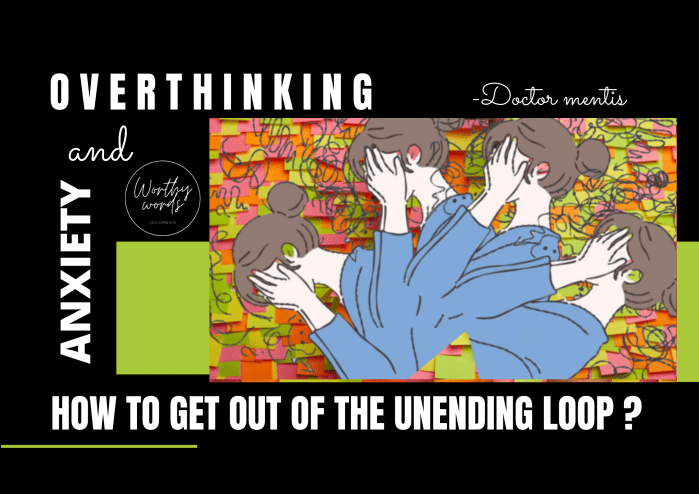
Are you a habitual over thinker? For anything that happened, good or bad, do you subconsciously crawl towards the W’s of the situation without even realizing it? Do you regularly feel your brain fogged with all these entangled loops of thoughts and end up having fatigue, breathlessness, tachycardia, and even chest pain? It’s the habit of overthinking leading to anxiety, that we are talking about here.
Anxiety is defined as intense, excessive, and persistent worry about everyday situations. This usually ends up with physical manifestations.
Anxiety more often than not is manifested in people who usually have tendencies to overthink. People with this tendency often go into a rumination about who is at fault in every situation they come across.
Smarter people acclimatized to using their thinking skills to clear up issues are especially vulnerable to this trap. They see their cogitation as a problem-solving strength, but, it’s not the correct means to use in every situation. You might find yourself having “shoulda, coulda” thoughts about what you could’ve done differently.
No, I’m not saying that overthinking is always a harmful thing.
Till you don’t allow it to make you uncontrollably anxious, it has its own chunk of benefits – Over thoughtful tendencies cause people to be appropriately vigilant, to always have backup plans, and to double-check every detail action. Feelings of self-doubt if not intensely negative, may help them stay open to diverse ideas and propel them to work harder.
So, you don’t have to eliminate this whole state from your life; you just need to learn to keep your anxiety system well-gauged.
I am telling this not only based on researches but also based on my personal experiences that – “Nothing wears you out more than going through the same pattern of negative thoughts over and over again.”
Overthinking or rumination not only affects your mental peace and productivity but also makes you vulnerable to both anxiety and depression. When you are overthinking, your mind incessantly goes on generating a spiral loop of ceaseless thoughts, over-analyzing people, situation and negatively judging yourself. While the thoughts seem like a big deal to you, most of the times, it’s possible to get out of this conglomerated network, your mind has woven (says expert).
Also, check the article on “Conflicts of emotion – healthy way to deal with sadness “. CLICK HERE
It’s found that feeling blue, depressed, or anxious, usually always has its roots in the habit of cerebration. Most of the time we tend to hole up over the past, agonize about the present, or perturb about the future. These all predominantly comprise of negative feelings which, if obsessed over for a long time can lead to hopelessness or loss of interest in life. It’s a self-defeating pattern, causing loss of time, energy, and mood.
So, now that we know about the problem and the havoc it can create in our lives, let’s see –
HOW TO GET OUT OF THIS SEEMINGLY UNENDING LOOP?
- Concentrating on other senses of perception to get yourself out of the thought world into the real world. Basically, use your five special senses to distract you from this chaos.
- Deep breathing- Time and again, breathing techniques have proven their unwavering efficacy in dealing with anxiety. Conscious emphasis on deep breaths is another way to bring you back from the toil of thoughts.
- Mindfulness and meditation- What could be better than mind-calming practices to calm your wild mind.
- Simply try being in the “here and now”.
- Keep a journal or diary to record the recurring thoughts. Writing is truly a great way to put it all out. Now since your thoughts will have a space in your diary to stay, they may actually leave the rented part of your brain.
{Written by DOCTOR MENTIS (WORTHYWORDS). – Based on various studies published on effects of overthinking on mental health.}
Discover more from Doctor Mentis
Subscribe to get the latest posts sent to your email.

 Doctor Mentis
0 comments on “OVERTHINKING AND ANXIETY: HOW TO GET OUT OF THE UNENDING LOOP ?”