

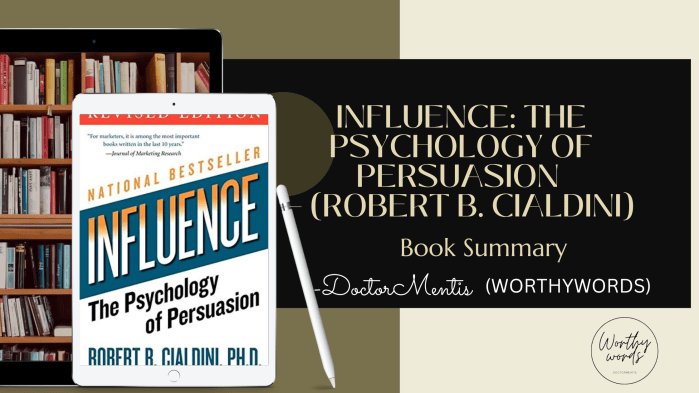
INTRODUCTION: -Having an influence on people around us is what everyone desires. We will be talking here about that based on the Book “Influence: The psychology of persuasion.” The whole book ( Get it here ) talks from 2 perspectives – One, is the perspective of an influencer. Second, the perspective of the influenced, and sums up the benefits and drawbacks these can offer.
The author talks about 6 principles of influence, which are RECIPROCITY, SCARCITY, AUTHORITY, CONSISTENCY, CONSENSES AND COMMITMENT & FRIENDSHIP AND LIKING.
Robert divides people into Burglars (ones who fumble away from using the principles of influence), Smugglers (who trick people for short-term results), and sleuths (who are more knowledgeable, and ethical and have more success by providing win-win situations).
He starts the book by forming the base with a pre-presentation of the actual effect of influence with CONCEPT OF CONTRAST. This states that the value of anything is almost always decided by the thing /event that happened just before it.
The best everyday life example for this is that if you put your hands in ice cold water and then put your hands in normal temperature water, the normal water will seem hot, but if you put your hand in the normal water after taking your hands out of hot water instead, you will find the same normal water as cold.
In business settings, if you show products from low price to high, the middle-priced items will seem more expensive, but if you show the same items from higher price to lower ones, the same middle range will now seem cheaper.
This tells us that even in the same situations, one thing that can change the perspective and thus the results is “WHAT GOES 1ST”.
PRINCIPLES: –
1. PRINCIPLE OF RECIPROCITY: – For ages, our society works with the rule of “YOU ARE OBLIGED TO GIVE BACK OTHERS, THE FORM OF BEHAVIOUR THEY HAVE GIVEN TO YOU.” For instance, if a shopkeeper provides you with good services, you are obliged to visit it again. Similarly, if a stranger gives you something, it creates discomfort in you until you can do something back for him (we end up owing them one). Keeping this in mind, you can increase whatever you want by doing it 1st.
“You want a favor, you do it 1st.
You want trust, you offer it 1st.
You want cooperation, you show it 1st.”
But it is important to not lose track by misreading this rule. The rule stands for the return of the exact same type of favor. Personal favor in return for a personal favor. Business favor in return for business favor. Mixing the two usually leads to a bad decision.
On the other hand, many times we end up bundling away the moment of influence after doing something for someone by saying things like, “Oh don’t think about it” or “No worry, I would have done it for anybody.” Instead, you can say things like, “You would do the same for me.” Just communicating the message of reciprocity should be enough.
Remember, you have not fabricated the situation but earned it. So, participate in the rule of reciprocity gracefully.
This is a general rule of nature and society works better when the ones who do genuine favors get genuine favors in return too. Otherwise, soon nobody will be doing favors for anyone anymore, as not every soul is a saint.
2. PRINCIPLE OF SCARCITY: – It says, “Usually the opportunities that are rare to find seems more attractive and worthy to people.”
A hall opened once in a year, a galaxy seen once in a lifetime, a product that is going to be out of stock. The most basic example of this can be if you have ever been a hostelite, the home food that you get once a year feels so valuable, but the same home food after staying a whole year at home losses its value somehow. (In Hindi we say it as, Ghar ki murgi daal barabar.)
Basically, when people know, what they cannot have, their desire for it shoots up. Research tells us that, people are more motivated by the thought of losing something than the thought of gaining something.
So to get yourself through, make it sure to present, what the person before you, can lose by not selecting your idea or product along with what he can gain.
But if you are on the other side, this competition for scarce resources can often lead you to bad decisions. So, to avoid this crisis, whenever you feel the signal of scarcity-driven emotion, take it as a yellow flag, step back and calculate. Don’t take decisions just to win against a competitor for the so-called scarce resource, but decide solely on its merits.
Be a sleuth in using the principle of scarcity by creating a win-win situation with the scarce resource without any deceit.
In business, for example, if you know the resource is scarce, the information about it being scarce is scarce too. Use it to inform the buyers. The double effect of this scarcity might double your sales too.
3. PRINCIPLE OF AUTHORITY: – To the influenced, this provides a shortcut for thoughts and results. If an authorized body says something, you need not sit and think about it all over again by yourself. It automatically becomes the truth or rule.
But on the other side of the road, when you are the influencer, you have to make it sure that people working for you are not following you blindly, which can decrease the creativity and productivity of the institution as a whole. You must communicate that any suggestion or solution from a knowledgeable person is welcomed but you are not compelled to follow all that comes.
The recipe is Expertise + trustworthy = Influence
Showcasing expertise increases the chance of people submitting to your authority. That’s what happens when a doctor displays all his certificates in his office or when an athlete displays all his medals and trophies in his hall. This is called “Inform to compliance”. No enforcement is needed. The same happens when before a speech or presentation, all your credentials and qualifications are put up. This indirectly tells the audience, what are you bringing to the table.
In situations where you do not have enough time, what is the trick to convey your trustworthiness across your table?
The author suggests that, before starting with your benefits, tell your negatives 1st. People will deem you more reliable if you put forward your negatives 1st. Just human psychology, but this makes you look more trustworthy and your positives now will have more authority over the listeners. (Just be aware of your line till which you can display your negatives without harming yourself.)
4. PRINCIPLE OF CONSENSUS: – “People are more convinced and affected by “PEOPLE PROOF” than the actual reality of a situation.” They follow what they think a lot of people are doing and start doing it themselves. They take the sound of others’ laughter as the consensus of whether they should laugh or not at a joke. They take others’ steps as the consensus for whether they should walk ahead or not.
As the INFLUENCED, it is okay to take consensus as a factor for the decision, but it’s wrong when it becomes the only factor.
On the other hand, as an INFLUENCER, showing a list of people on your side to add value to your work acts on this factor. More influence is imparted if the list of people you are showing has people similar to the person you approach or someone he knows.
E.g. if you give a fresher man, a statistic showing similar results of their seniors as fresher but they excelled, later on, they’ll tend to excel more believing that fact.
5. PRINCIPLE OF CONSISTENCY: – Before starting with this principle, we must know that consistency may become a trap if it gets into auto mode.
Commitment usually leads to consistency. When left to its own devices, change is rarely a permanent thing. Activity solidifies commitments and prevents the efforts of influence from evaporating with time. Action can be in form of writing.
Research shows that, when those written statements are made public, people tend more to stick to those commitments. (Not telling you to make all written testaments public, though.)
The second factor that determines the efficacy of commitments is a person’s own will.
Finding and publicizing genuine and consensus testimonials are thus one of the best ways to influence.
6. PRINCIPLE OF FRIENDSHIP AND LIKING: – “It’s harder to reject claims and requests of people who are from your circle or whom you like.” Studies show there are three basic criteria that influence one’s liking towards others. These are:
SIMILARITY– We like people, who are like us in some way or the other.
PRAISE– We like people, who do like us. Most people are unbelievably suckers for flattery (Still take out the time for genuine praises instead of hollow compliments.)
COOPERATION– Collaboration and moving towards one goal increase liking and influence.
And thus, goes down the bars as they no longer doubt if they can trust you because it’s believed generally that people don’t fabricate people they like. So, the trust increases.
(Written by DOCTOR MENTIS (WORTHYWORDS). Summary based on the book INFLUENCE: THE PSYCHOLOGY OF PERSUASION by ROBERT B. CIALDINI.) Complete book – SHOP NOW
Discover more from Doctor Mentis
Subscribe to get the latest posts sent to your email.

 Doctor Mentis
0 comments on “HOW TO BE INFLUENTIAL AND PERSUADE PEOPLE EFFECTIVELY. (Based on ROBERT B. CIALDINI’s Book)”