

I. LEARN TO STAND
- The Principle of Present: –
This Shaolin principle teaches us to “Accept the moment. To accept everything that is linked to it, to accept what it will lead to. Accept the moment without judging it, without comparing it with the past and future.” It means understanding that each moment in life- whether we value it or let it pass unhealed- will never come back. The moment you start criticizing the moment, think- What would it change about the moment? Each individual moment comes, goes, and never returns. There may be similar moments, better or worse, funnier or sadder, but the one that has just passed will never come back. Even two pictures taken half a second apart do not show the same moment.
So, know that life is here and now, whether we like it or not. If anything would have been different at any point, we would not be where we currently are. But the point is, nothing was different, so it is entirely pointless to think about the possibilities of changing the past.
2. The Principle of Mindfulness: –
“Whether you observe or ignore things, do it consciously.” The Shaolin principle of mindfulness teaches us to understand that nothing, absolutely nothing, is self-evident, even if it appears to be so and we accept it as such. Mindfulness encompasses attention and respect: attention to the moment and respect towards everything around us. Passing judgment clouds our minds. We must be objective and unbiased towards every moment and every being, even if we will often find this difficult. Mindfulness teaches us to recognize our own abilities and those of our opponents.
3. The Principle of Resoluteness: –
When you draw your sword, in your mind you must be prepared to kill the opponent. Wanting without determination is like a heavy milestone that you hang around your own neck. It takes up an enormous amount of energy that you will lack elsewhere. The third Shaolin principle teaches us to “Either do things wholeheartedly or not at all.” It teaches us that we should do only what we are truly determined- and willing- to do. It tells us to cling to the plan and continue along the path we originally decided on. If you decide to do something every day, you must actually do it every day even if at times you don’t feel like doing it.
Lethargy weakens resolves. This principle teaches us to accept things we cannot change for the moment and do what is necessary. Act, don’t react. The Shaolin principle of resoluteness teaches us, “Those who act change the course of the world and the lives of other people.” A journey of a thousand miles begins with a single step. The principle of resoluteness reminds us to take precisely this first step.
4. The Principle of Detachment: –
Greed fundamentally is deeply a human emotion. It is so human that it distinguishes us from all other creatures on earth. Have you ever heard of a lion who killed ten zebras more than he can eat, so that he can sell them later? Of course, you haven’t. Animals live in the moment and know that there will always be enough available for them to comfortably survive. The fourth Shaolin principle teaches us that “It is precisely this greed that makes us predictable, vulnerable, and susceptible to coercion. Those who do not have their greed in check, give others the power over themselves and their emotions and are thus easier to attack.” The Shaolin principle teaches us that being detached does NOT mean that we must forego things. It is not a barter, not a sacrifice to obtain something else in return.
II. LEARN TO BE STRONG
5. The Principle of calmness: –
The Shaolin principle of calmness teaches us that- “Conscious inaction can be an effective means of defense- if we employ it with right resolve.” Your opponent has a plan and is merely waiting for your reaction to execute it. Defensive moves that are emotionally motivated cloud the ability to discern the true intention of the attacker. An over-conscientious attitude also reveals a lack of calmness. If you can control your fear of your opponent, you’ve already won half the battle. If you’re not calm, a little provocation may reveal all your intentions. The same applies to your opponent. Anger is the most common representation of a lack of calmness. Remember your anger harms only you. So simply refrain from any kind of reaction. Tell yourself: Even if I have a different opinion, it doesn’t matter. I will simply stop talking.
6. The principle of Slowness: –
Haste leads to mistakes. Someone who is asked to just quickly sign this is about to walk into a trap. Sometimes in life, you need to force yourself to slow down. The Principle of calmness taught us not to give an answer before we’re asked. The Principle of Slowness goes a step further. If we know only the beginning of the answer to a question, it makes sense to answer so slowly that the person asking is no longer interested in hearing the end. It is sometimes better to do nothing than to achieve nothing with a lot of effort. You should know that- to be able to do something swiftly, you must begin by learning to do it slowly.
7. The Principle of imitation:-
Someone who imitates others can avoid repeating their mistakes. Confucius said that there are three methods by which we can learn wisdom: First, by reflection, which is the noblest; second by imitation, which is the easiest; and third by experience, which is the bitterest. But we need to reflect on what is worth imitating. Imitation as the Shaolin Principle teaches us- facilitates deep insight into the essence of others. It reveals their thinking, their feelings and allows us to predict their actions and reactions to our behavior. Empathy is a form of imitation only. This helps in anticipation of the opponent’s argument. If you want to get your way with someone, you must put yourself in their shoes. It is easier to win over with empathy by getting on the same wavelength. Contradicting in the first sentence will push you towards losing to your opponent without even starting. But if you agree for the first few times and then contradict them, you will probably be deemed competent and be received well.
8. The Principle of Opportunity:-
There is nothing in this world that does not have its decisive moment. Life is not interested in your plans and does not go by them. In life, it is important to wait for the right moment, and it is equally important to be ready to act when that moment arrives. That doesn’t mean you’ll not even plan the path, as opportunities do not arise independently. There is a proverb saying- If one does not know, to which port one is sailing, no wind is favorable. This principle teaches us to adjust according to the opportunity. It teaches us to pluck the apples that have just ripened and prepare a feast with them. Attempting to force opportunities will only make you go hungry. So, sow the seeds, seize the opportunities that come your way, and don’t get carried away by grand visions. The principle works well with arguments too. Good warriors will launch their attack when their concentration is at its peak, and the adversary is possibly diverted. The more inflexible an opponent is, the less dangerous they are as not everything will ever go as per anyone’s plans.
9. The Principle of Yielding:-
Yielding is a concealed weapon; our opponents can virtually never recognize when we employ it. As we read earlier, stiffness is a companion of death, and flexibility is a companion of life. This Shaolin principle teaches us to Yield and thus allow the opponent’s energy to dissipate. If you are in an argument, simply don’t react, at some point, your opponent will feel foolish. Or better keep agreeing with them, it works wonders in making them furious while arguing. Let the other person scream and shout until at some point they have used all their energy and all that they said puts them deep in your debt. Here your focus must not be on demonstrating your bravery, but solely on gaining the upper hand. Bulldozing doesn’t work every time. If you simply sidestep the attack, it flies right past. Pretend to be weak so your opponent may grow arrogant. People are so greedy to win over others that when they see an opportunity to do so, they forget everything else. The Shaolin principle teaches us always to give our opponents room for an apparent victory. It teaches us that the soft triumphs over the hard. Yielding is a form of defense, but at the same time, it is an attack that the opponent launches against themselves.
to be continued………………………..
Next up……..
III. LEARN TO WIN
10. The Principle of superiority:-
11. The Principle of Letting go:-
12. The Principle of Self-knowledge:-
13. The Principle of Community:-
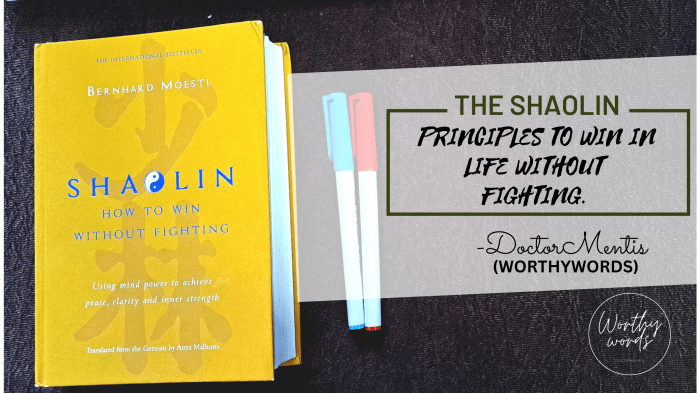
[Written by DOCTOR MENTIS (WORTHY WORDS). Based on SHAOLIN book.]
{Reference read – Bernard Moestl’s book- “SHAOLIN”- How to win without fighting. GET HERE}
Discover more from Doctor Mentis
Subscribe to get the latest posts sent to your email.

 Doctor Mentis
0 comments on “HOW TO WIN IN LIFE WITHOUT FIGHTING? -[SHAOLIN PRINCIPLES]”