

Most people who know about Essential Tremor know it as a movement disorder — the involuntary shaking of hands, the difficulty holding a cup steady, the tremor that shows up most when you try to do something precise. What far fewer people know is that for many with ET, the struggle doesn’t end when the day does. The nights are just as disrupted.
A growing body of research, including a significant polysomnographic study out of NIMHANS, Bengaluru, is now putting sleep disturbances in Essential Tremor firmly on the clinical map. Here’s what we know — and why it matters.
What Is Essential Tremor?
Essential Tremor is the most common adult movement disorder, characterized by involuntary, rhythmic shaking — most often affecting the hands, though the head, voice, and limbs can be involved too. It is largely idiopathic, meaning there’s no single known cause, and it is clinically distinct from Parkinson’s disease, though the two are sometimes confused.
A subset of patients falls under the classification of Essential Tremor Plus (ET-Plus) — individuals who have the classic tremor along with additional soft neurological signs such as gait disturbances, subtle cognitive changes, or mild dystonia. Whether ET-Plus is a distinct entity or simply a broader expression of the same spectrum is still an evolving area of research, but it has become a useful clinical distinction.
What’s becoming increasingly clear is that ET is not purely a motor disorder. Non-motor symptoms — including sleep disturbances, anxiety, and cognitive difficulties — are now recognized as part of the picture for many patients.
Why Sleep? The Role of Polysomnography
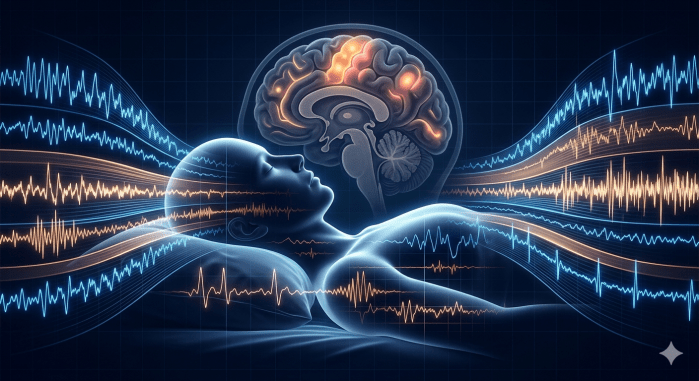
To truly understand what’s happening during sleep, researchers turn to Polysomnography (PSG) — the gold-standard diagnostic sleep study. PSG simultaneously records brain activity (EEG), eye movements (EOG), muscle activity (EMG), heart rhythm (ECG), respiratory effort, and blood oxygen saturation throughout the night.
This comprehensive snapshot allows clinicians to identify abnormalities in sleep architecture and diagnose specific sleep disorders including insomnia, obstructive sleep apnea, Restless Legs Syndrome (RLS), and REM Sleep Behavior Disorder (RBD) — conditions that a patient might not even realize they have, attributing their exhaustion simply to “bad sleep.”
What the NIMHANS Study Found
A recent study by Singh et al. (2024), conducted at NIMHANS, Bengaluru, used PSG to evaluate sleep in 26 ET patients, 19 ET-Plus patients, and 45 healthy controls. The findings were striking.
Both ET and ET-Plus patients showed significant sleep architecture abnormalities compared to healthy controls. Importantly, the two patient groups did not differ significantly from each other on most PSG metrics — meaning ET-Plus did not consistently show worse sleep than ET, despite the broader neurological involvement.
Key findings included:
Reduced sleep efficiency and prolonged wakefulness: Both groups had notably lower sleep efficiency and significantly increased Wake After Sleep Onset (WASO) — meaning patients were spending more of their time in bed lying awake rather than asleep.
Altered sleep stage distribution: There was a meaningful reduction in the percentage of deeper sleep stages (N2 and N3) and prolonged REM sleep latency — suggesting that patients were not only sleeping less, but that the sleep they were getting was lighter and less restorative.
Higher prevalence of sleep disorder features: ET and ET-Plus patients showed higher rates of RLS-like symptoms, RBD-related features, and obstructive sleep apnea-related metrics (including elevated apnea-hypopnea index and snoring index) compared to controls. It’s worth noting that full PSG-confirmed RBD was present in only a small number of patients — so these findings reflect a higher burden of symptoms and associated features, not necessarily confirmed diagnoses across the board.
Why This Has Clinical Consequences
Poor sleep in Essential Tremor is not just a comfort issue — it has real downstream effects on health and function.
Disrupted, non-restorative sleep can worsen tremor severity itself, reducing a patient’s ability to manage daily tasks. It contributes to excessive daytime sleepiness, which compounds disability. And chronically poor sleep is one of the more reliable pathways into anxiety and depression — something we’ve explored at length in the context of overthinking, spiralling thought patterns and the way unexpressed sadness accumulates over time.
For ET-Plus patients, who already carry a greater cognitive and neurological burden, sleep disruption adds another layer of difficulty. There is growing — though still emerging — evidence linking sleep dysfunction in ET to accelerated cognitive decline, making early identification especially important.
This pattern is not unique to ET. We see it across chronic neurological and physical conditions — from Chronic Fatigue Syndrome to chronic pain — where the physical condition and sleep disruption feed each other in a cycle that is hard to interrupt without addressing both simultaneously. And as we’ve discussed in the context of sleep disorders and mental health more broadly, the relationship between poor sleep and psychological wellbeing runs deep, regardless of age or underlying condition.
What Can Be Done
Management of sleep disorders in Essential Tremor should follow general sleep-medicine principles, tailored to the individual patient and their confirmed diagnosis — the NIMHANS study itself identified the problem rather than testing specific treatment protocols. That said, the standard clinical toolkit includes:
For RLS: Dopaminergic agents and iron supplementation where indicated, depending on confirmed diagnosis and serum ferritin levels.
For RBD-related features: Melatonin is commonly used; environmental safety modifications are also recommended where RBD is confirmed.
For obstructive sleep apnea: CPAP therapy remains the most effective intervention for confirmed OSA and can meaningfully improve both sleep architecture and daytime functioning.
For insomnia: Cognitive Behavioral Therapy for Insomnia (CBT-I) is the first-line, evidence-based non-pharmacological approach and has shown consistent efficacy across a wide range of patient populations.
Lifestyle and sleep hygiene: Consistent sleep-wake schedules, limiting caffeine and alcohol, reducing screen exposure before bed, and regular physical activity all support better sleep quality — and these are relevant to everyone with ET, regardless of whether a specific disorder is confirmed.
If you or someone you know has Essential Tremor and is experiencing persistent fatigue, daytime sleepiness, or non-restorative sleep, raising this with a neurologist or sleep specialist is worth doing. A formal sleep evaluation — including PSG where indicated — can uncover treatable conditions that might otherwise go unaddressed for years.
Where Research Goes from Here
The NIMHANS study is an important step, but the field needs more. Longitudinal data are still lacking — we don’t yet know with certainty whether sleep abnormalities precede motor symptoms and could serve as early markers of disease, or whether they develop in parallel as the condition progresses. Investigating the impact of targeted sleep interventions on tremor severity and overall disease course will be equally important. This is an area where neurologists and sleep medicine specialists will increasingly need to work together.
This article is for informational purposes only and does not constitute medical advice. Please consult a qualified healthcare professional for personalized guidance.
Written by DOCTOR MENTIS — Where Mind and Body Meets.
References
- Singh, R. P., Mythirayee, S., Seshagiri, D. V., Kumar, G., Mohale, R., & Pal, P. K. (2024). Polysomnographic Evaluation of Sleep Disorders in Essential Tremor and Essential Tremor Plus: A Comparison With Healthy Controls. Journal of Movement Disorders, 18(1), 45.
- Jiménez-Jiménez, F. J., Alonso-Navarro, H., García-Martín, E., & Agúndez, J. A. G. (2020). Sleep disorders in essential tremor: systematic review and meta-analysis. Sleep, 43(9), zsaa039.
- Barut, B. O., Tascilar, N., & Varo, A. (2015). Sleep disturbances in essential tremor and Parkinson disease: a polysomnographic study. Journal of Clinical Sleep Medicine, 11(6), 655–662.
Further Reading
• National Institute of Neurological Disorders and Stroke. (n.d.). Essential Tremor Information Page. Retrieved from https://www.ninds.nih.gov/health-information/disorders/essential-tremor
• American Academy of Sleep Medicine. (n.d.). Sleep Education. Retrieved from https://sleepeducation.org/
• National Sleep Foundation. (n.d.). Sleep Disorders. Retrieved from https://www.sleepfoundation.org/sleep-disorders
⸻
Note: This article is intended for informational purposes only and should not be considered medical advice. For personalized recommendations, please consult a healthcare professional.
Discover more from Doctor Mentis
Subscribe to get the latest posts sent to your email.


0 comments on “Polysomnographic for When the Tremor Doesn’t Let You Sleep: Understanding Sleep Disorders in Essential Tremor”