

If you or someone you know is struggling, you don’t have to wait for a “good enough” reason to reach out. In India,

We tend to think of suicide as an individual tragedy — a private ending to a private struggle. The data insists on a different frame. More than 720,000 people die by suicide worldwide every year, and suicide remains the third leading cause of death among 15–29-year-olds globally. That’s not a footnote to public health. It’s a barometer of it. We’ve touched on how steep that curve has gotten among young people in our earlier look at rising teen anxiety and depression.
We’re currently in the middle of the 2024–2026 triennial World Suicide Prevention Day theme, “Changing the Narrative on Suicide.” The call to action attached to it — “Start the Conversation” — is deceptively simple. It isn’t asking us to raise awareness in the abstract. It’s asking us to move from a culture of silence and stigma toward one of openness, equity, and evidence-based policy.
The Geography of a Global Crisis
One of the more uncomfortable adjustments in this field has been letting go of a high-income-country bias that shaped suicide prevention research and messaging for decades. The assumption that this is primarily a “wealthy nation” problem doesn’t survive contact with the numbers: 73% of all suicides occur in low- and middle-income countries.
That statistic should reorganize how global health policy gets built. If three-quarters of the burden sits in resource-limited settings, then strategies designed around high-income assumptions — well-funded crisis lines, dense psychiatric infrastructure, insurance-backed therapy access — will always underserve the majority of people at risk. Effective prevention has to be built for the realities of the places where most deaths are actually happening. India’s own answer to that access gap is worth a look — we covered it in our piece on Tele MANAS and mental health access in India.
The Conversation Paradox: Asking Saves Lives
There’s a persistent fear in health communication that talking about suicide directly might “plant the idea” or tip someone toward acting on it. The evidence says the opposite. Asking someone directly whether they’re thinking about suicide doesn’t increase the risk — it tends to reduce anxiety and helps the person feel less alone with it.
That reframes “starting the conversation” from a soft, feel-good campaign slogan into a genuinely practical tool. Asking the question doesn’t hand someone an idea they didn’t already have. It hands them an opening — a chance to say the thing out loud and be met with something other than silence.
Beyond the Diagnosis: A Multisectoral Model
It’s tempting to treat suicide as a purely clinical problem — something that happens because of an underlying psychiatric diagnosis. That’s only part of the picture, and treating it as the whole picture leaves a lot of people unaccounted for.
Suicide is frequently an impulsive response to a breakdown in someone’s ability to cope with acute stress, not necessarily a diagnosed condition. Meaningful prevention has to reach further than the clinic, into the social determinants of health and the specific pressures that push people into crisis:
- Financial instability, relationship breakdowns, and chronic pain
- The heightened risk faced by marginalized groups, including prisoners and LGBTI individuals
- The compounding isolation and discrimination experienced by refugees, migrants, and Indigenous communities
Schools are one of the few institutions positioned to catch these pressures early, which is why we’ve argued schools need a bigger role in student suicide prevention.
The Myth of Fixed Determination
There’s a belief — common enough that it shapes how people respond, or fail to respond, in a crisis — that if someone is determined to die, nothing will stop them. The evidence doesn’t support this. Most people in suicidal crisis are ambivalent. They aren’t seeking death specifically; they’re seeking relief from pain that feels unbearable and, crucially, feels permanent even when it isn’t.
Because so many suicidal acts are impulsive, the most effective intervention is often the simplest one available: buying time. Emotional support offered at the right moment can let an acute crisis pass. Follow-up studies of people who survive near-fatal, high-lethality attempts consistently find that most are glad to have survived.
A Surprising Physical Intervention: The Pesticide Link
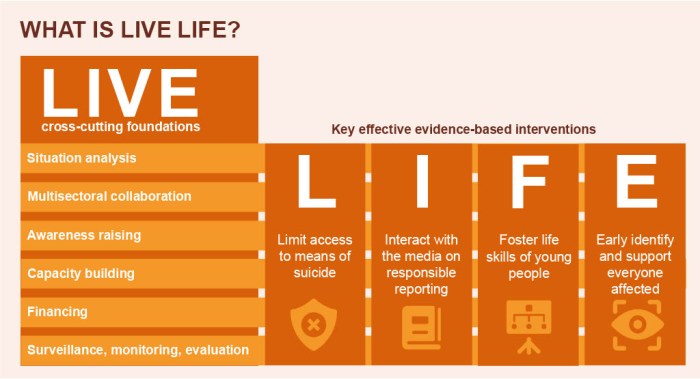
Prevention isn’t only about therapy rooms and hotlines. It’s also about the physical environment someone is standing in during a crisis. Restricting access to highly hazardous pesticides is one of the most cost-effective, evidence-backed pillars of WHO’s LIVE LIFE initiative — and it’s a striking example of how “means restriction” saves lives without requiring a single conversation to happen first.
In many low- and middle-income countries, self-poisoning with pesticides is a leading method of suicide. Nearly a fifth of suicides worldwide involve pesticide self-poisoning. Making that method physically harder to access doesn’t eliminate the underlying crisis, but it does what means restriction always does: it buys time for the impulsive urge to pass, and for someone — a neighbor, a family member, a stranger — to intervene. It’s the same logic behind the digital tools we explored in our piece on digital mental health interventions — small structural changes that buy a person time to reach help.
The LIVE LIFE Framework for Action
WHO’s LIVE LIFE guide moves prevention out of the psychiatrist’s office and into the community, organizing action around four interventions:
- L – Limiting access to means: restricting access to pesticides, firearms, and specific medications
- I – Interacting with media: partnering with journalists on responsible reporting to prevent copycat behavior
- F – Fostering life skills: building socio-emotional programs that help adolescents and young people cope
- E – Early identification: training communities to recognize, assess, and support people affected by suicide and self-harm
A Call for Systemic Accountability
The shift from taboo to evidence-based policy is real progress, but it’s worth being honest about how far there is left to go. Only 38 countries currently have a documented national suicide prevention strategy — a gap that undercuts everything the LIVE LIFE framework is trying to build.
Changing the narrative isn’t just a messaging exercise. It’s a demand that suicide prevention and mental health get treated as top-tier public policy priorities everywhere, not just where the infrastructure already exists. Wherever you’re reading this from, there’s a version of “starting the conversation” available to you — a check-in text, a direct question to someone who seems to be struggling, a willingness to sit with an uncomfortable topic instead of steering around it. Every one of those small moments is part of the same larger shift.
References
- World Health Organization. “Suicide prevention.” WHO Health Topics.
- World Health Organization. “Suicide worldwide in 2021: global health estimates.”
- World Health Organization. “LIVE LIFE: An implementation guide for suicide prevention in countries.”
- International Association for Suicide Prevention. “World Suicide Prevention Day 2024–2026: Changing the Narrative on Suicide.”
- World Health Organization. “WHO guides toward global target of reducing suicide rate by one-third by 2030.”
Further Reading
- World Health Organization — Preventing Suicide: A Global Imperative (2014)
- International Association for Suicide Prevention — World Suicide Prevention Day resources hub
- WHO Regional Office for South-East Asia — Suicide prevention in the South-East Asia Region
- iCall (TISS) — Psychosocial helpline and resources, India
Discover more from Doctor Mentis
Subscribe to get the latest posts sent to your email.

 Doctor Mentis
0 comments on “Why Everything You Think You Know About Suicide Prevention Might Be Changing”